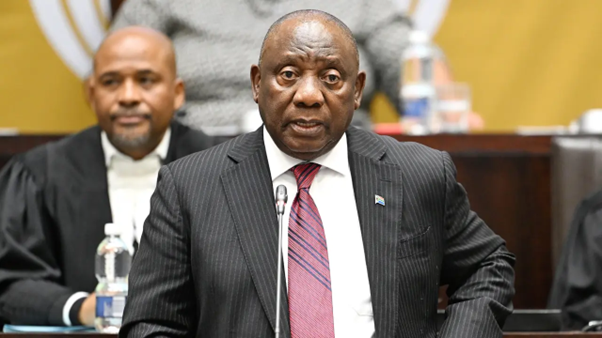

President Cyril Ramaphosa braced himself for a robust questions and answers session before Parliament where he will face enquiries concerning the purpose of national dialogue, economic growth, the proposal for a state-owned national bank and the imposition of new trade tariffs on South Africa by the United States (US), among other things. This took place on Tuesday. This will be the president’s first appearance in a session of the National Assembly since the mid-year recess in meeting his obligation to answer set questions from MPs at least once a quarter. In a separate session Deputy President Paul Mashatile will face questions in the National Council of Provinces (NCOP).
Last month, the US introduced new trade tariffs for South Africa that Ramaphosa on Monday told Brazil Russia India China and South Africa (BRICS) heads of state are already having an impact on employment. Labelling the tariffs as “senseless”, Economic Freedom Fighters (EFF) leader Julius Malema expects Ramaphosa to explain what impact he thinks they will have on current and future diplomatic relations with the US. The African National Congress (ANC)’ chief whip Mdumiseni Ntuli, meanwhile, wants to know how government intends supporting the Postbank so that government’s intentions for a state bank can be realised. The Democratic Alliance (DA)’s chief whip George Michalakis has posed a question about the intended outcome of the National Dialogue – which the party boycotted last month – and whether it’s intended to facilitate economic growth, poverty reduction and job creation.

Ramaphosa finds himself performing a balancing act on a political tightrope. On the one hand both opposition parties and members of the ruling coalition are asking questions to scrutinize Ramaphosa’s sincerity and conduct in leading South Africa and on the other he as to find a solution (if he’s trying) to the imposition of US President Donald Trump’s tariffs. The Postbank saga is a significant scandal where poor and rural communities were supposed to be assisted in receiving loans. The creation of a state-owned bank that is licenced by the government is in itself a Pandora’s box as there is the issue concerning who will be appointed to run it. The National Dialogue is another questionable matter whose purpose was never fully defined. Due to the withdrawal of several legacy foundations such as the Thabo Mbeki and Steve Biko foundations the Dialogue began to be portrayed as a rubber stamp endorsement of government policy.
Despite these criticisms President Ramaphosa insists that National Dialogue in Pretoria was created for South African citizens at heart.

“The outcomes of the National Dialogue will be determined by the citizens of this country,” the President told Members of Parliament on Tuesday. He was responding to a question from George Michalakis of the Democratic Alliance, who asked whether the National Dialogue was intended to support government priorities, such as economic growth, poverty reduction, job creation, lowering the cost of living, and building a capable state. The President said the National Dialogue should be understood as a structured process that brings together citizens, political actors, civil society, and other stakeholders to deliberate on the future of the country. “The National Dialogue is aimed at giving ordinary South Africans a voice to articulate precisely the South Africa they want and how they can participate in crafting the solutions of our country,” he said.
The President highlighted that the first National Convention, held in August at UNISA in Tshwane, brought together more than 1 000 delegates from over 200 organisations spanning around 30 sectors of society.
South Africa has a long path of obstacles to thread. As a nation we must take a good long hard look at our selves and where we want to go. South Africa is a hub of opportunity and it is incumbentRamaphosa and the Government of National Unity must harness that. The National Dialogue was a notable failure when it came to pressing forward transparency and accountability. The withdrawal of key legacy foundations such as former President Thabo Mbeki’s exposed there was pressure to conform to certain perspectives and planned ideals of the state. That said the DA and George Michalakis are right to point out the African National Congress led GNU’s shortcomings in tackling poverty reduction, economic growth, job creation and other challenges. A more substantial stance needs to be taken by the Ramaphosa administration.
Civil society organizations need not just debate and be debated with but they also need to be listened too. Business, civil society organizations and other interest groups across the spectrum need to express their beliefs about what path the country needs to take. Ramaphosa for his part has the responsibility to listen and to lead.
Article written by:
Yacoob Cassim
Journalist at Radio Al Ansaar