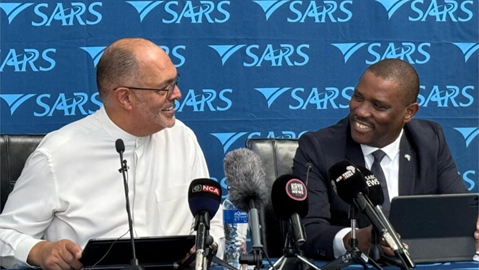

South African Revenue Service (SARS) Commissioner-designate Dr. Ngobane Johnstone Makhubu stated in an official announcement that the R3 per litre fuel tax relief granted to South African consumers in April will need to be repaid in one form or another. Speaking at an introductory briefing on his appointment as the new SARS head, Makhubu explained that the revenue service has been set a challenging collection target for 2026/27. Following the agency’s recorded R2 trillion in revenue in 2025/26, SARS has now been tasked with collecting R2.13 trillion in the 2026/27 fiscal year.

This task will be challenged by “the headwinds that are already starting to bloom,” he said, referring to the chaos caused by the United States’s war in Iran. The war has triggered a global energy crisis, sending fuel prices skyrocketing as shipments through the Strait of Hormuz were blocked. Because of the crisis, fuel prices were expected to shoot up by over R6 a litre for petrol and over R10 a litre for diesel in April. However, Finance Minister Enoch Godongwana announced last-minute relief for fuel users, granting a R3 per litre cut to fuel taxes. Outgoing SARS commissioner Edward Kieswetter said the key caveat is that the National Treasury’s fuel levy relief is only valid for a month. The levy cut was not intended to be a long-term solution, but a pause for the government and local finance authorities to assess the situation.
“The month is really to give us time to understand [the length], the severity and the magnitude of this crisis,” Kieswetter said.

The tax relief on the fuel levy will ultimately need to be repaid to the Treasury in some form. A higher tax is certainly one possible mechanism. A fuel levy functions as a subsidy – helping to keep fuel prices artificially low for consumers while supporting oil companies. In return, the South African economy is able to continue operating more smoothly. However, once again it appears that South Africa, like many other countries, will need to look closer to home for a stable source of fossil fuel. Another alternative is for the government and private sector to accelerate the development of sustainable renewable energy solutions for South African motorists and households. Regarding the war in Iran, a two‑month ceasefire has been declared, and the Strait of Hormuz has reopened, allowing petrol prices to ease. When it comes to calming markets, energy prices remain the key factor.
Without sufficient energy, the economy risks grinding to a halt. The length, severity, and magnitude of the crisis have been somewhat capped by the recent ceasefire, but a “wait‑and‑see” approach will dominate the next two months.
Meanwhile, South African businesses have experienced growth since the beginning of March. This is reflected in the launch of new projects that have increased staffing capacity. Notably, the rate of job creation was the highest recorded since May 2024.
South African businesses improve in March due to various factors. The improvement among South African businesses resulted in a rise in employment. Businesses also built up inventories during March. Total inventories rose for the first time in four months and at the fastest rate since May 2025. However, the war in the Middle East contributed to supply chain stresses. The resulting uncertainty created client hesitancy. Consequently, this affected new orders. Input price inflation accelerated, driven by rising fuel prices, a weaker rand due to a stronger US dollar and changes to the minimum wage. In response, output charges were lifted to the greatest extent in just over a year.
Where output was lifted, companies reported taking on new projects and renewed efforts to build stocks. New project starts were also a factor behind an increase in staffing capacity. Surprisingly, the rate of job creation was the strongest observed since May 2024.
It is a positive sign when South African businesses adapt to changing circumstances beyond anyone’s control. The government and President Cyril Ramaphosa could learn from how local businesses not only survive but thrive. Economically, a short reprieve has occurred as a ceasefire was agreed upon between the United States and Iran, leading to fuel prices dropping to more reasonable levels. South African businesses must remain prepared for shocks in international markets, such as a protracted war. It is always wise to have a contingency plan in place to secure the one essential commodity – energy for generation and transport – from a reliable source.
The South African economy can grow again if businesses continue diversifying through new projects and ventures to replenish stocks. SARS will need to find a way to recover the cost of fuel price subsidies without undermining South Africans’ livelihoods. The trajectory of fuel prices may be determined in the next two months.
Article written by:
Yacoob Cassim
Journalist at Radio Al Ansaar