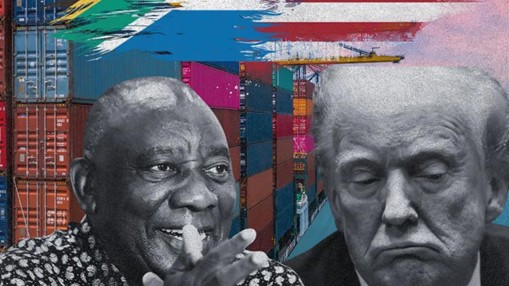

President Cyril Ramaphosa response to the tariffs imposed by United States (US) President Donald Trump in Parliament, Cape Town was to come out guns blazing. President Ramaphosa told MPs that “South Africa will not be bullied by anyone”. The gloves are off. Pretoria is intensifying efforts to safeguard the economy and negotiate a better trade deal with Washington. Ramaphosa was answering questions in the National Assembly on Tuesday. His statement concerning the tariffs was in direct response to a question by Economic Freedom Fighters (EFF) leader Julius Malema, who raised concerns over the potential economic damage caused by Trump’s trade restrictions.

According to the president, over 600 US companies are invested in South Africa, and 22 South African companies operate in the US making South Africa the largest African investor in the American economy. In the country, the cabinet has approved a local economic support package to assist businesses directly affected by tariffs. This includes funding from the Localisation Support Fund and an export competitiveness program focused on short- to medium-term relief, such as working capital and upgrading equipment. Ramaphosa stressed that the tariff setback also presents an opportunity to diversify. “We are accelerating efforts to open new export markets, including Latin America, Asia, and the Middle East,” he said, citing the African Continental Free Trade Area (AfCFTA) as a key pillar for future growth.
He added that the government is promoting local procurement—encouraging businesses, consumers, and the state to prioritise South African-made goods.

Ramaphosa’s plan is for South Africa to set its eye on greener pastures. Whether it’s in its extended neighbourhood of Africa, or other economic powerhouse regions of the world. The US has chosen to shut its doors to trade and investment from the rest of the world. Trump’s miscalculation could see the United States decline. Ramaphosa for his part is hoping for the opportunity for a better trade agreement with Washington. Those twenty-two businesses affected by the loss of business in America will definitely need the assistance of the Localisation Support Fund. They will have to look elsewhere for the competition of their businesses. The export competitiveness programme will be a key part in rehabilitating these businesses and saving the jobs they provide. It is best not to put all your eggs in one basket.
When one door is shut in your face there is always the opportunity of another opening. If you know where to look. South African citizens and businesses are now expected to prioritize local goods over foreign ones. Meanwhile a key market for South African visitors is the common African market known as African Continental Free Trade Agreement (AfCFTA).
Ramaphosa described the African trade area as “central to our economic vision”. “We are actively working with the AfCFTA secretariat to finalise value-chain protocols in automotive, agro-processing, pharmaceuticals and textiles,” he said in Japan.
He also backed harmonising “Rules of Origin” – the standards that define where a product is made – to promote African manufacturing and improve border infrastructure for faster trade. Such rules create consistency in trade agreements, cut complexity, close loopholes and streamline customs. The World Bank projects that full AfCFTA implementation could raise the continent’s income by 7% by 2035. For South Africa, the ISS estimates the economy could be 11.6% larger by 2043, with exports up $85.2 billion (42.8%). This includes a $35.6 billion (28%) boost to manufacturing and $1.2 billion (11.5%) for agriculture.
Essentially, South Africa hopes to position itself as a key anchor in the continent’s 1.4 billion people-strong market.
South Africa is still on the rise economically if Ramaphosa, his ministers and advisors know how to harness that rise. South Africa is inextricably linked to Africa as one of its economic gateways. Value-chain protocols refers to the structured standards and methodologies which will guide AfCFTA signatories as a whole in assessing, managing, and optimizing the activities across their entire value chain. This extends from raw material sourcing to the disposal of produce. A major focus will be on sustainability, fuel emissions trafficking, ethical sourcing and lifecycle analysis. At the heart of these laws is the “Rules of Origin” that will ensure copy right for products to be claimed according to their place of origin. An increase in South African exports would lead to the generation of income from sources closer to home.
The times are changing new alliances and relations are being forged. South Africa now more than ever needs to balance itself between American trade and African business.
Article written by:
Yacoob Cassim
Journalist at Radio Al Ansaar