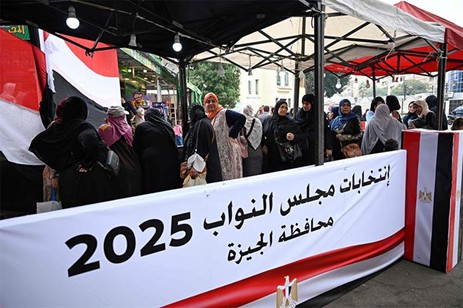

Egypt’s National Elections Authority prepares for the first phase of parliamentary elections for the nation’s lower house. These elections are being contested by a wide range of political parties but those most expected to obtain the majority of seats in the chamber agree on most issues of substance. This includes their staunch support for authoritarian President Abdel Fatah el-Sisi. El-Sisi himself who took power through the military in a coup in 2013 never formed or joined a political party of his own. The voting process commenced on Monday the 10th of November, nearly two years after the army strongman was elected to a third, six-year term the final term he is supposedly allowed under the country’s constitution.
The polling is held over several phases and continues over five weeks. Egypt is the most populous nation in the Middle East after Iran. El-Sisi could use the support of pro-regime parties in the new parliament to stay in power indefinitely.

Unlike those days (between 2011-2013), however – when Islamists, liberals, socialists and regime loyalists waged hardscrabble campaigns for hearts and minds – the parties are now broadly aligned as they try to drum up enthusiasm among a disengaged electorate. They are also running together under a hybrid voting system that allocates a little under half of seats to closed party lists. This year only one list made the ballot – one that gives the lion’s share of seats to three pro-government parties, meaning many lawmakers were effectively guaranteed a win before the first vote was cast. Several opposition figures were barred from competing as individual candidates, including both ultraconservative Islamists and leftists, based on a new interpretation of a military service requirement. Campaign costs and medical screening kept others out.
Critics say such moves have left many voters apathetic, especially after being worn down by years of economic hardship. Turnout in a vote for parliament’s advisory upper house this summer was just above 17%. At one polling station in Giza, a 58-year-old electrician who gave his name as Amgad said people working for the candidates had bussed him in to vote, but he wasn’t sure who those candidates were, since “all the delegates work together.”

The Egyptian people had sort to campaign for an end to the dictatorial rule of long time President Muhammad Hosni Mubarak and for democratic dispensation in 2011. The election of the hard line ultra conservative Muhammad Morsi was deeply divisive and ultimately unstable. Now with El-Sisi there is the likelihood he will stay in power indefinitely. The alignment of the pro- El-Sisi Parties in parliament may usher in the promise of a fourth term for El-Sisi and the possibility of him eventually transferring power to his eldest son Mahmoud Abdel Fattah Saeed Hussein Khalil El-Sisi. In El-Sisi senior’s Egypt holding the powerful to account through transparent institutions is elusive. Parliament and the country’s highest judiciary, the Supreme Constitutional Court remain virtual rubber stamps for the regime’s policies. Once el-Sisi moves Egypt’s centres of power fully from Cairo to the as yet unnamed New Administrative Capital to the south east there will be no challenging his rule with another uprising.
It would be impossible for all candidates contesting the election to have performed a requirement in military service making the criteria highly selective. The political parties in question are separate in name only. It has been pre-ordained that they will work together on approving the government’s agenda. This parliament is certain to be a compliant soft toothed puppy in El-Sisi’s control. The lack of existence of any formal credible opposition in Egypt that is civilian poses a long-term risk and could at some point become increasingly delicate, leaving the Nile Valley nation vulnerable to future crises.

Article written by:
Yacoob Cassim
Journalist at Radio Al Ansaar