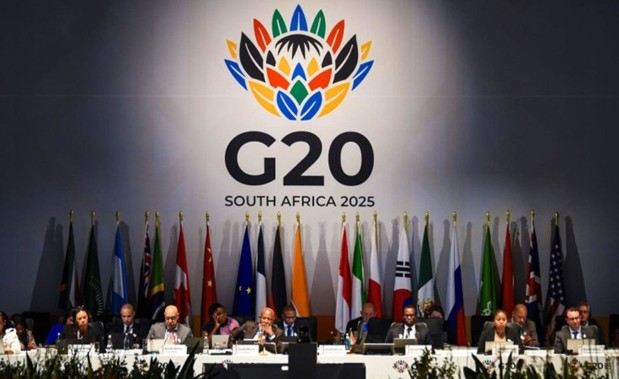

As the Group of Twenty (G20) gathers in Johannesburg, South Africa for the G20 Summit, economic experts are calling on the bloc to commit to strong action in response to an all-encompassing debt crisis. The rapidly growing debt crisis, is being experienced across the developing world and Africa. The upcoming Summit over which President Cyril Ramaphosa will preside will focus on African debt sustainability as low – and middle – income countries urge reforms to avoid debt derailing stability. There are several priority areas to address, including the G20 Common Framework for debt treatment, transparency, and innovative financial mechanisms such as debt derailing development.
In the absence of US President Donald J. Trump, the remaining G20 leaders will discuss several priority areas including the G20 Common Framework for Debt Treatment, debt transparency, and innovative financial mechanisms such as debt-for- climate swaps. To achieve this goal, it will be necessary to reduce the high cost of capital and improve access to reliable financing for development. The G20 Ministerial Declaration on the Debt Sustainability signals a Commitment to tackle unsustainable debt and rising financing costs, particularly in Africa, through cross border communication.

Martha Tukahirwa, Regional Coordinator for Africa at Fight Inequality Alliance, said that the reality is that the global economy is just not faltering. “Right now, it’s extractive, it’s exclusionary, it’s highly unstable.” Debt justice must be viewed through the lens of those bearing the heaviest consequences, Tukahirwa believes. “It is important to situate our arguments in the lived realities of those who are bearing the brunt. And also bearing in mind that those who are bearing the brunt are mostly women, you know, girls, and gender-diverse people,” said Tukahirwa. “Because, again, those are the ones that are carrying the care burden and, and having to, you know, feed economies, and whilst all that is happening, they’re also bearing the band of high taxes, and, and also, what unstable… what unstable living realities look like.” She said that while the G20 brings together the world’s largest economies, it excludes the vast majority, the 99%.
“This means that there is the 99% that are seated on the margins, that do not have a seat at the table, and so this is an opportunity,” she said. “This is an opportunity for global solidarity, this is an opportunity for us to come together. She announced the We The 99 People Summit, a parallel space for global solidarity, which is going to happen on the auspices of the G20, is this space to really build a shared narrative to create a shared agenda.

The major bone of contention that every, day common people of ordinary stock face is high taxes. If the member states of the G20 were to consider being more inclusive of the classes that make up the base of the world economic machine as well as tax the rich, those G20 governments need to consider ensuring all social classes including the rich pay taxes in accordance with their incomes. If the wealthy pay taxes in accordance with their incomes, then this could be invested in the poor through business and economic training programmes. Supporting the growth of small businesses in the face of mega corporations around the world should be a step in prioritising the needs of the many over the few. Household heads are struggling to make ends meet and to ensure their families have enough to eat. The working classes of the world need stability and inclusion in international forums such as the G20. Inclusion is their democratic right.
Tukahirwa’s announcement that there would be an inclusive Summit for the disenfranchised (the ninety nine percent) on the margins of the G20 is an interesting take on crises engulfing most of the planet. The matter of the United States not sending a delegation to Johannesburg for the summit when they are the main contributors of most these crises could lead to Washington being isolated in most international circles. The 99 People Summit is a pragmatic forum where concerns, fears and solutions are raised. Debt in the developing world has risen to 25% since 2029.
Trevor Manuel, the chair of the G20 Africa Expert Panel and South Africa’s former finance minister, called the extensive discussion surrounding debt this year the “flavor of the year” for financial regulators worldwide. Manuel said the necessity of finding fundamental solutions to the debt crisis rather than just making minor adjustments to the system’s flaws. He criticized the discrepancy in the cost of capital for developing nations, using comparative data for Namibia vs. Germany and Egypt vs. Canada to demonstrate how the current system, influenced by rating agencies, leads to significantly higher bond yields for emerging markets despite healthier debt-to-GDP ratios or growth rates. “They take countries out of the debt market circulation for considerable periods of time,” Manuel said. “As (UN Special Envoy on Financing Sustainable Development Mahmoud) Mohieldin had said, G20 methodology is not inclusive. It’s punitive for countries to default.”
Former minister of Finance Trevor Manuel possesses a steady hand to Africa’s agenda and role at the Summit. It was the right choice to have him head the expert panel. Hopefully Manuel’s voice of reason will be heard at the G20 Summit. Delegates and leaders should listen to his arguments. Manuel recognized that when the rich create debt such as through Wealth Sovereign funds it is the poor who bear the burden. Manuel is certainly right to argue that there needs to be fundamental changes to limit the institutionalization of corporate and industrialist greed. No stone should be left unturned in curbing the amount of debt created by the ultra-wealthy. The constant addiction of governments to borrowing billions in the long term needs to stop. Wealth regeneration rather than wealth spending should be the main priority for the G20.
In the coming days the balance of economic power should shift depending on how talks unfold and what solutions are reached.
Article written by:
Yacoob Cassim
Journalist at Radio Al Ansaar