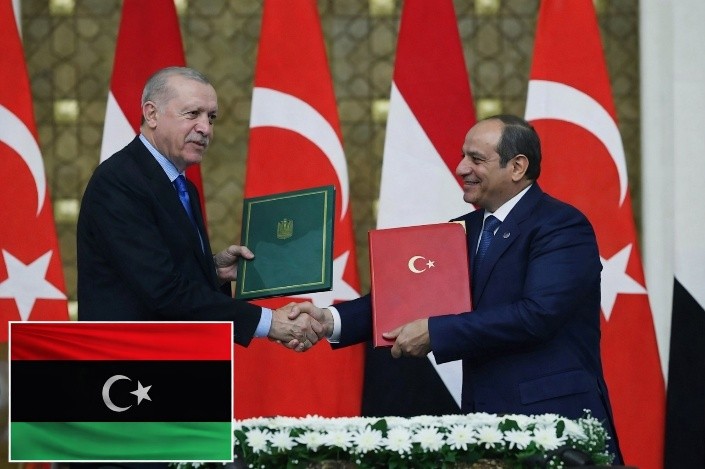

Egypt and Türkiye are holding face-to-face high-level meetings which has culminated in the first visit by an Egyptian Defence Minister to Ankara in thirteen years. This has raised questions on whether Egypt and Türkiye’s rapidly expanding cooperation can ease conflicts where both nations have interests in conflict zones such as Libya, Somalia, the Sudan, the Sahel etc. The Libyan conflict is a particular concern.

Bashir Abdel Fattah, a Türkiye affairs specialist at the Al-Ahram Center for Political and Strategic Studies, said the rapprochement had at least prevented confrontation in Libya, where Cairo and Ankara once backed rival interests. He noted that the growing political understanding between the two countries has helped de-escalate the conflict and support efforts toward a political settlement that preserves Libya’s territorial integrity. Türkiye analyst Mahmoud Alloush shared that assessment, describing Egyptian-Turkish coordination as a turning point in Libya and noting parallel efforts involving Saudi Arabia to advance a political solution. Not everyone is convinced. Rokha Ahmed Hassan, a member of the Egyptian Council for Foreign Affairs, said expectations that Egyptian-Turkish understandings would help resolve Libya’s crisis have yet to be realized, largely because of divisions among Libyan parties.

Both Turkish President Recep Tayyip Erdogan and Egyptian President Abdel Fattah El Sisi were at loggerheads since 2023, when a military coup de e tat in Egypt brought El Sisi to power through unseating the country’s first democratically elected President Mohammed Morsi a one-time ally of Erdogan. Both leaders, alongside Saudi Crown Prince Mohammed bin Salman (MBS) had sought to shape the engulfing chaos of the Arab Spring revolts which began in 2011. Libya following Colonel Muammar Qaddafi’s fall from grace was no exception. In Libya Erdogan supported the legitimate and democratically elected administration of the Government of National Unity (GNU) in Tripoli, while El Sisi’s Egypt supported General Khalifa Haftar who commands the Libyan National Army (LNA) based in the east, which backs up a rival government in Tobruk, known as the Government of National Stability (GNS/HoR).
Egypt as Libya’s eastern neighbour wants a stable border on its west and does not wish to risk a refugee crisis. Türkiye wants a stable ally in the Libyan state. Both see eye to eye and want a unified secure Libya that will not be the source of another refugee crisis.

The GNA, recognized by the United Nations, has struggled to exert its authority across the nation, facing opposition from the LNA, which controls significant portions of eastern Libya. This rivalry has been exacerbated by international interventions, with various countries supporting different factions through military and financial means. The situation is further complicated by the presence of extremist groups that exploit the chaos, further destabilizing the region. In addition to the main conflict between the GNA and LNA, Libya’s south remains a hotbed of ethnic tensions and rivalries among tribes. These local disputes often intersect with the broader national conflict, complicating peace efforts and the delivery of humanitarian aid. The complex web of alliances and hostilities has made Libya a mosaic of contested regions, with each faction maintaining its base of power and governance structures.
A fractured Libya is not in the interests of either the Turks or the Egyptians, nor is it within the best interests of other interested regional powers such as Qatar which supports the GNU alongside the United Nations nor the United Arab Emirates (UAE) and Russia which supports Haftar and his LNA alongside Egypt. Both sides want to see an end to the conflict and stalemate that has ensued since Qaddafi’s fall. Democratic elections in Libya have not been held since 2021. At the heart of this is the need to consider what solution the Libyan people desire. Right now, an uneasy truce reigns with neither the GNA in Tripoli nor Haftar being able to take control over the whole of Libya. In essence there are divided loyalties with some even preferring the restoration of the former constitutional monarchy that was overthrown in 1969 by Qaddafi. This is supported alongside the reinstatement of the 1951 constitution that could see a return to the federation of the three regions of Libya.
Türkiye maintains a staunch military presence in Libya’s west, while the rest of the country remains divided by tribalism. Ankara also has entrenched maritime interests on Libya’s coastal waters and uses and influences tribal militias as proxies. Sectarianism, ethnicity and tribalism remains a dominant feature but autonomy under a federal system could help to rectify the situation, leading to disarmament.
Neither El Sisi nor Erdogan for whatever reason seems to be interested in the restoration of the old Libyan Throne. However, with the current situation in the country this is gaining momentum, with current pretender Prince Mohammed El-Senussi being a possible candidate for the country’s monarch. El-Senussi is the grandnephew of Libya’s late deposed king Idris Bin Abdullah El-Senussi who commands respect amongst the country’s youth and clans. There is still opposition from the country’s major factions and support for a republican government is also a competitive, although this could be chaotic, depending on whether it be a presidential or parliamentary system. Only time will tell how the situation plays out.
Article written by:
Yacoob Cassim
Journalist at Radio Al Ansaar