
Death is usually followed by a funeral within days.
For Iran, it took more than four months.
After funeral ceremonies began on Friday, 3 July, millions of mourners packed the streets of Tehran on Monday, 6 July, as the funeral procession for Ayatollah Ali Khamenei reached its largest and most significant stage. His death came during one of the most turbulent periods in Iran’s recent history, as conflict involving Iran, Israel and the United States disrupted what would ordinarily have been an immediate state funeral. Instead, months passed before the country could publicly honour the man who led the Islamic Republic for nearly four decades.
That delay has made this far more than a funeral.
It has become Iran’s first opportunity to mourn together after months of war, uncertainty and political upheaval.
Rather than holding a single ceremony, Iran organised a week-long farewell spanning several cities in Iran and Iraq. The funeral programme began on Friday, 3 July, with religious ceremonies and the arrival of foreign delegations in Tehran before Monday’s mass public procession through the capital. In the coming days, the ceremonies will continue before concluding with Khamenei’s burial on Thursday, 9 July, at the revered Imam Reza Shrine in Mashhad, his birthplace and one of the holiest sites in Shia Islam. The extended programme has allowed millions of mourners, many of whom were unable to grieve publicly during the conflict, the opportunity to pay their final respects.
For many Iranians, there has never been an Iran without Ayatollah Ali Khamenei as Supreme Leader. Entire generations grew up under his leadership. Those lining the streets of Tehran were therefore not simply attending a funeral; they were witnessing the end of an era that shaped the country’s politics, religious identity and place in the Middle East for nearly forty years.
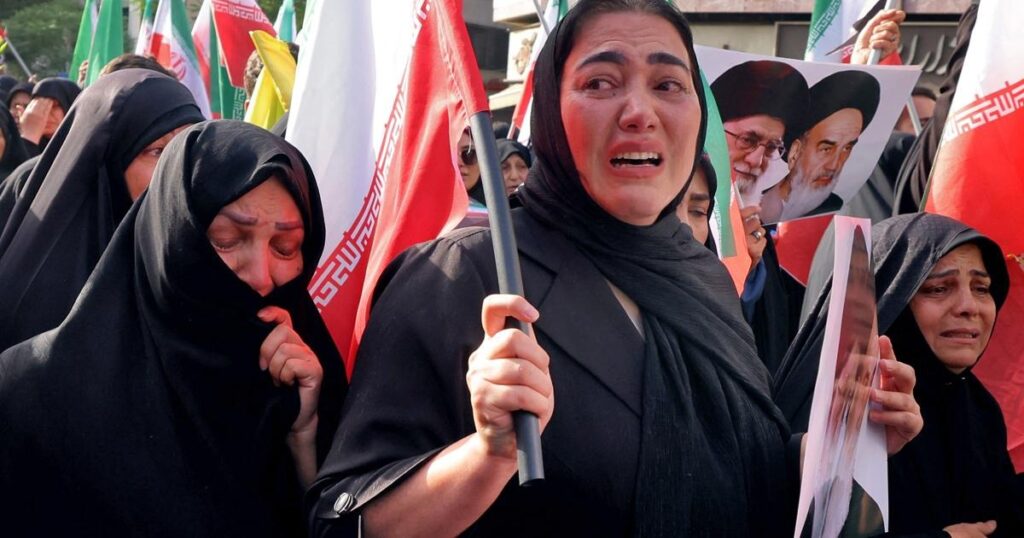
The scale of Monday’s procession reflected that reality. Streets overflowed with mourners carrying Iranian flags, Qur’ans and portraits of the late leader. As the flag-draped coffin moved slowly through the capital, many reached out in prayer while others stood silently, tears visible as religious chants echoed through the crowd. Roads were closed, security was tightened and much of Tehran came to a standstill during what is being described as one of the largest state funerals in Iran’s modern history.
Yet the funeral is serving another purpose beyond remembrance.
It is also Iran’s first major demonstration of national unity since the war. The carefully organised ceremonies, attended by senior political leaders, military commanders, religious scholars and foreign delegations, project an image of stability at a time when many outside the country have questioned Iran’s future following months of conflict. The message is clear: despite the loss of its long-time leader, the state intends to show that its institutions remain intact and that the transition of leadership is continuing.
One detail, however, attracted almost as much attention as the funeral itself. While Khamenei’s three surviving sons appeared during the ceremonies, his successor as Supreme Leader, Ayatollah Mojtaba Khamenei, was notably absent. Iranian officials have not provided a detailed public explanation, although reports indicate he is recovering from injuries sustained during the conflict. His absence has fuelled widespread discussion both inside Iran and abroad as the country begins adjusting to its new leadership.
The atmosphere throughout the procession reflected both grief and defiance. Alongside prayers for the deceased, chants condemning the United States and Israel echoed through sections of the crowd, highlighting that the wounds of the recent conflict remain raw. For many mourners, the funeral became more than a farewell to a leader—it was also an expression of resilience, national solidarity and hope that the country can move forward after one of the most difficult periods in its recent history.
For Muslims around the world, the ceremonies also carry deep religious significance. Honouring the deceased, gathering for collective prayer and accompanying a funeral procession are traditions deeply rooted in Islam. Khamenei’s burial at the Imam Reza Shrine on Thursday, 9 July, adds further spiritual importance, making this farewell meaningful not only for Iranians but for many within the wider Shia Muslim community.
When the final prayers are offered in Mashhad on Thursday, 9 July, Iran will not simply be burying its longest-serving leader. It will be closing one of the most influential chapters in the history of the Islamic Republic. The crowds will disperse, the flags will be lowered and the mourning will eventually come to an end.
What will not end are the questions.
How Iran’s new leadership responds to regional tensions, international pressure and the legacy left by Ayatollah Ali Khamenei will shape not only the country’s future, but the future of the Middle East. In many ways, this funeral is not the end of the story—it is the beginning of Iran’s next chapter.
Article written by:
Hudaa Ahmed
Journalist at Radio Al Ansaar